
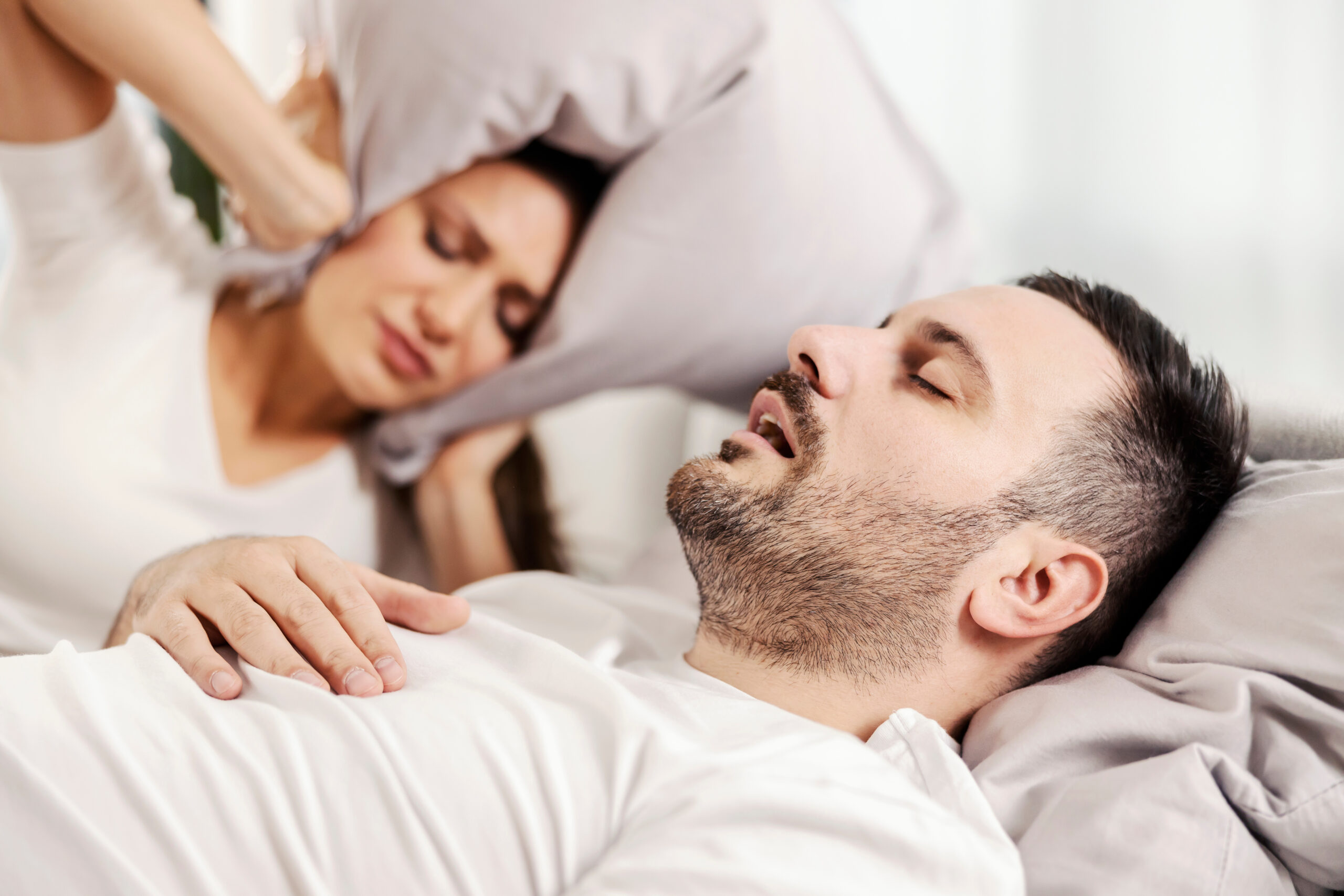
Snoring vs. Sleep Apnea: How to Tell the Difference and When to Worry
August 14, 2026
Quick answer
Snoring is the vibrating sound of air passing through relaxed tissues in your throat, while sleep apnea is a medical condition in which the airway repeatedly collapses, interrupting breathing during sleep. At White Mountain Dental, we encourage patients to pay attention to loud snoring accompanied by pauses in breathing, gasping, or daytime exhaustion, as these may be signs of sleep apnea and should be evaluated by a medical professional.
of adult dental patients reported habitual snoring in one study
oxygen drop used to score a breathing event
events per hour can indicate sleep apnea
Key takeaways
- Snoring is a sound; obstructive sleep apnea is a breathing disorder that briefly stops airflow during sleep.
- Witnessed breathing pauses, gasping, choking, and heavy daytime sleepiness are the strongest warning signs of sleep apnea.
- A sleep study measures your Apnea-Hypopnea Index (AHI) to confirm the diagnosis and grade its severity.
- Treatment ranges from lifestyle and positional changes to CPAP and a custom oral appliance fitted by your dentist.
- Your North Conway, NH dentist can screen for sleep apnea and coordinate care with a sleep physician.
Snoring vs. Sleep Apnea: The Quick Answer
The short answer: snoring is a sound, while sleep apnea is a breathing disorder. Snoring happens when air vibrates against soft tissues in a narrowed throat. Obstructive sleep apnea (OSA) happens when that airway collapses far enough to briefly stop your breathing, often many times per night.
The key difference in one sentence
If you make noise but keep breathing steadily, that is usually simple snoring; if your breathing repeatedly pauses, stops, or ends in a gasp, that points toward sleep apnea. According to the American Dental Association, obstructive sleep apnea involves repeated episodes of partial or complete airway blockage during sleep.
Why the distinction matters for your health
Simple snoring is mostly a social and sleep-quality nuisance. Untreated sleep apnea, on the other hand, is linked to high blood pressure, heart problems, and daytime fatigue that raises accident risk. Knowing which one you have changes everything about how you should respond.
What Is Simple (Primary) Snoring?
At White Mountain Dental, we explain that simple snoring is noisy breathing during sleep without pauses or drops in oxygen. It is common and, for many people, harmless, though it can still disturb a bed partner.
What causes the snoring sound
When you fall asleep, the muscles of your throat, tongue, and soft palate relax. As air moves through this narrowed space, the tissues vibrate, producing sound. The narrower the passage, the louder and more turbulent the noise tends to be, as summarized in this review on the diagnosis and treatment of snoring in adults.
Common triggers
- Excess weight: extra tissue around the neck narrows the airway.
- Alcohol before bed: it over-relaxes throat muscles.
- Sleep position: lying on your back lets the tongue fall backward.
- Nasal congestion: allergies or a cold force mouth breathing and vibration.
What Is Obstructive Sleep Apnea (OSA)?
Obstructive sleep apnea is a medical condition in which the airway repeatedly narrows or fully collapses during sleep, briefly cutting off airflow. Your brain senses the drop in oxygen and nudges you awake just enough to reopen the airway, often with a gasp or snort.
How airway collapse interrupts breathing
Each collapse can last ten seconds or longer and may repeat dozens or hundreds of times a night. You usually will not remember these micro-awakenings, but they fragment your sleep and strain your heart and blood vessels.
How common OSA and habitual snoring really are
Both are more widespread than most people assume. In a study of adult dental patients, roughly one in four reported habitual snoring, and a meaningful share screened as high risk for obstructive sleep apnea, according to research on the prevalence of snoring and OSA symptoms in dental patients. That overlap is exactly why the dental chair is a useful place to catch warning signs early.
How to Tell the Difference at Home
You can look for a clear pattern at home, but only a sleep study can confirm sleep apnea. Ask a bed partner to observe your breathing, or record yourself sleeping. Here is a practical way to compare what you notice.
Points to simple snoring
- Steady, rhythmic snoring sound
- No breathing pauses observed
- You wake up reasonably refreshed
- Snoring worsens only with alcohol or a cold
- Snoring eases when you shift off your back
Points to sleep apnea
- Loud snoring broken by silent pauses
- Gasping, choking, or snorting awake
- Morning headaches and dry mouth
- Heavy daytime sleepiness or dozing off
- Trouble concentrating or mood changes
What gets mistaken for sleep apnea
Several conditions can mimic sleep apnea. Simple loud snoring, nighttime acid reflux, poorly managed allergies or nasal congestion, insomnia, and even fatigue from an underactive thyroid can all cause disrupted, unrefreshing sleep. That is why self-diagnosis is unreliable, and a proper evaluation matters.
When to Worry: Red Flags That Warrant a Doctor Visit
See a healthcare provider if your snoring comes with breathing pauses, gasping, or persistent exhaustion. These signs move you from a snoring nuisance into possible sleep apnea territory.
Symptoms you should never ignore
- A partner who witnesses you stop breathing during sleep
- Waking suddenly gasping or choking
- Excessive daytime sleepiness, especially while driving
- Morning headaches and a dry, sore throat
- High blood pressure that is hard to control
A word from Dr. Harry Gulati at White Mountain Dental
“When patients tell me their partner has stopped sleeping in the same room because of loud snoring and gasping, I take that seriously. Those pauses in breathing are the detail that separates ordinary snoring from something that needs a medical sleep evaluation.”
Health risks of untreated sleep apnea
Left untreated, obstructive sleep apnea is associated with high blood pressure, heart disease, stroke risk, type 2 diabetes, and daytime impairment. The repeated oxygen dips and disturbed sleep place ongoing stress on the cardiovascular system, which is why timely diagnosis is so important.
How Sleep Apnea Is Diagnosed
Sleep apnea is diagnosed with a sleep study, either in a lab or with a home testing device prescribed by a physician. The study records your breathing, oxygen levels, and other signals to count how often your airway is compromised.
Sleep studies, the AHI, and the 3% rule
The main result is the Apnea-Hypopnea Index (AHI), the average number of breathing events per hour of sleep. An apnea is a near-total pause in airflow, while a hypopnea is a partial reduction. The “3% rule” refers to how a hypopnea is often scored: reduced airflow paired with roughly a 3% drop in blood oxygen (or an arousal from sleep) counts as an event. A higher AHI means more severe apnea, and this number guides treatment decisions.
Talk with your provider
Share your symptoms, bed-partner observations, and any recordings.
Complete a sleep study
Testing measures airflow, oxygen, and breathing events overnight.
Review your AHI
Your physician grades severity and recommends a treatment plan.
Begin therapy and follow up
Treatment is adjusted over time to keep your airway open.
The role of your dentist in screening
Your dentist is often the first to spot clues. Signs such as tooth grinding, a scalloped tongue, a large tongue, a narrow airway, and reports of loud snoring can prompt a screening conversation and a referral for testing. Regular general care visits are a natural moment to raise these concerns.
Treatment Options for Snoring and Sleep Apnea
Treatment depends on whether you have simple snoring or confirmed sleep apnea and how severe it is. Options range from simple habit changes to medical devices and custom dental appliances.
Lifestyle changes and positional therapy
For many people, small changes help. Losing excess weight, avoiding alcohol near bedtime, treating nasal congestion, and improving sleep habits can all reduce snoring. Positional therapy is the “pillow trick”: encouraging side sleeping instead of back sleeping so the tongue does not fall backward. A body pillow, a wedge, or a specialty pillow can help you hold the position through the night.
CPAP therapy
Continuous positive airway pressure (CPAP) is the standard treatment for moderate-to-severe obstructive sleep apnea. A quiet machine delivers a steady stream of air through a mask to hold the airway open. It is highly effective when used consistently, though some people find the mask hard to tolerate.
Talk to a North Conway, NH Dentist About Your Snoring
If snoring is disrupting your sleep or your household, a conversation with a North Conway, NH dentist is a smart first step. We can screen for warning signs, discuss whether testing is appropriate, and, when indicated, fit a custom oral appliance.
How we screen and coordinate care
At White Mountain Dental, Dr. Harry Gulati reviews your symptoms, examines your airway and bite, and coordinates with a sleep physician for diagnosis when needed. If a sleep study confirms obstructive sleep apnea, we can fabricate and adjust an oral appliance and monitor your response over time. Call us at 603-356-6505 to ask about a snoring and sleep screening.
Meet Dr. Harry Gulati
Dr. Harry Gulati, BDS, DMD, CAGS, brings extensive clinical, academic, and research experience to Androscoggin Valley Dental. He earned his Bachelor of Dental Surgery from Dr. D.Y. Patil Dental School, his Certificate of Advanced Graduate Studies in Restorative and Esthetic Dentistry from Boston University, and his Doctor of Dental Medicine from Tufts University School of Dental Medicine. He also completed advanced training in implant dentistry through the International Academy of Dental Implantology.
Known for his calm and patient-centered approach, Dr. Gulati provides preventive, restorative, cosmetic, and implant care with a strong focus on long-term function and natural-looking results. He takes the time to explain treatment options clearly, helping patients feel informed, comfortable, and confident throughout their care.
Beyond private practice, Dr. Gulati has served as an Associate Clinical Professor at Tufts University School of Dental Medicine, where his responsibilities have included clinical instruction, diagnosis, treatment planning, and mentoring dental students. He has lectured nationally and internationally on restorative dentistry, dental education, and the treatment of endodontically treated teeth. His professional contributions also include published research, editorial and journal-review roles, dental product evaluation, and participation in organizations such as the American Dental Association, Academy of General Dentistry, and American Dental Education Association.
Dr. Gulati’s commitment to dentistry extends into the community through volunteer dental screenings, outreach programs, fundraising, and services supporting children and underserved populations. His dedication to clinical care, education, and service has earned several honors, including Incisal Edge’s Top 40 Under 40 recognition, the Doctors’ Choice Award, and fellowship in the International College of Dentists.
Learn more about Dr. Gulati’s professional background and accomplishments on his LinkedIn profile.
Frequently asked questions
Q: How do I know if I have sleep apnea or I just snore?
Simple snoring is a steady sound without breathing pauses, and you usually wake up reasonably rested. Sleep apnea involves loud snoring broken by silent pauses, gasping or choking awake, and heavy daytime sleepiness. If a partner notices you stop breathing, ask a physician about a sleep study, since only testing can confirm the diagnosis.
Q: What is the 3% rule for sleep apnea?
The 3% rule describes how a hypopnea, a partial reduction in airflow during sleep, is scored. A breathing event is counted when reduced airflow is paired with roughly a 3% drop in blood oxygen or an arousal from sleep. These events are totaled to calculate your Apnea-Hypopnea Index, which grades severity.
Q: What is the pillow trick against sleep apnea?
The pillow trick is a form of positional therapy that encourages side sleeping rather than back sleeping, so the tongue does not fall back and block the airway. A body pillow, wedge pillow, or specialty pillow helps you hold the side position. It can reduce snoring and mild positional apnea but is not a substitute for medical treatment in moderate to severe cases.
Q: What gets mistaken for sleep apnea?
At White Mountain Dental, we understand that simple loud snoring, nighttime acid reflux, poorly controlled nasal allergies or congestion, insomnia, and fatigue from conditions like an underactive thyroid can all mimic sleep apnea by causing disrupted, unrefreshing sleep. Because these symptoms can overlap, a proper evaluation and, when needed, a sleep study are the most reliable ways to tell them apart.
For directions, use this helpful Google Maps link or get step-by-step navigation via Get Directions.
Remember: Wear your aligners all the time, removing them only for brushing and flossing, since consistent wear is essential for correcting buck teeth on schedule.
Disclaimer: This article is for general information only and does not replace a personalized evaluation with a qualified dentist.
